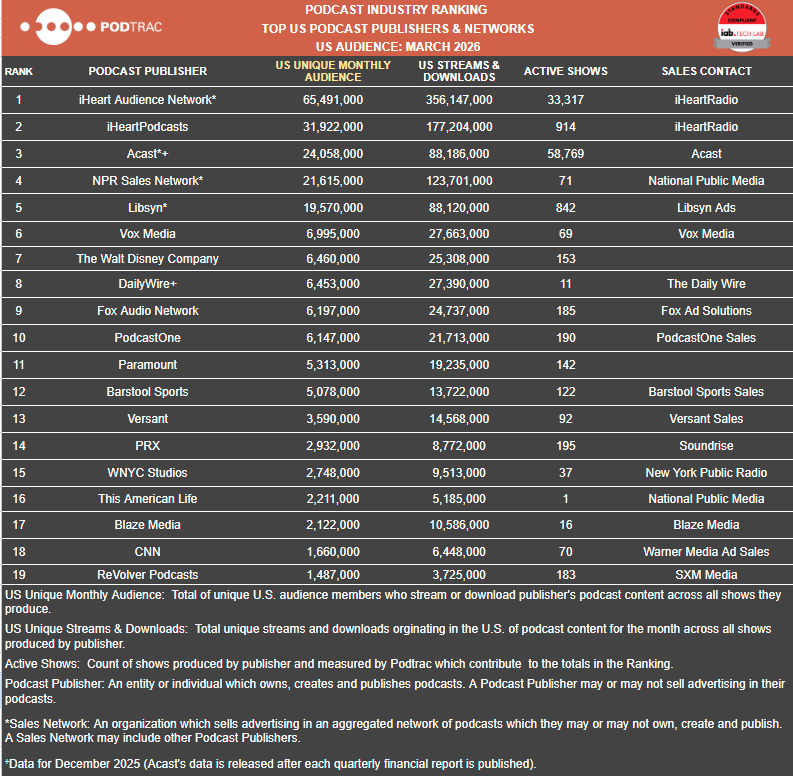
Podtrac, the podcast measurement and analytics platform owned by SiriusXM, released its March 2026 rankings on April 9, 2026, showing robust month-over-month growth across the industry’s largest publishers and networks, with top 20 publishers posting combined download increases of 11.7 percent and standout performers including Paramount and This American Life each logging growth rates exceeding 20 percent in audience size.
The March rankings, now available on Podtrac.com, track performance metrics across the top U.S. and global publishers, networks, and individual podcasts, providing critical market intelligence for an industry increasingly focused on quantifiable audience measurement and advertiser-friendly data. The release also introduced a new feature: country-level podcast rankings for 35 nations, expanding Podtrac’s geographic coverage and offering producers and networks detailed insights into international listening patterns. The platform welcomed Versant into its publisher rankings during the March period, reflecting the continued expansion of tracked networks in the measurement ecosystem.
The March results were notably bolstered by the calendar effect of February’s brevity, which compressed the previous month’s downloads into a shorter timeframe and allowed for more favorable comparisons when March’s full 31 days were tallied. Despite this technical advantage, the breadth of growth across the publisher ecosystem signals sustained listener engagement and advertiser interest in podcast content heading into the spring advertising season. Every publisher tracked in the top 20 recorded positive month-over-month growth in both audience size and download volume, a metric that Podtrac highlighted as representative of the health of the podcast industry broadly.
Paramount, the media conglomerate’s podcast division, emerged as one of March’s strongest performers, with audience figures climbing 21 percent month-over-month and downloads surging 25 percent over the same period. This American Life, the public radio narrative journalism program distributed through multiple platforms and networks, posted even more impressive gains, with audience size up 22 percent and downloads accelerating 31 percent month-over-month. These performances underscore the continued dominance of established media brands and public broadcasting institutions in the podcast ecosystem, even as newer independent creators and smaller networks compete for listener attention and advertising dollars.
The inclusion of country-level rankings across 35 markets represents a significant expansion of Podtrac’s analytical capabilities and reflects growing demand from international podcast producers, networks, and advertisers seeking granular data about listening patterns outside the United States. The U.S. market remains the largest and most mature podcast market globally, but growth in international listening, particularly in Canada, the United Kingdom, Australia, Germany, and Scandinavia, has prompted analytics firms to invest in regional ranking infrastructure. Podtrac’s move to offer country-specific rankings positions the platform as a comprehensive solution for publishers with global ambitions or those seeking to understand their performance in specific geographic markets.
For the broader podcast industry, Podtrac’s rankings function as an essential barometer of commercial health and audience momentum. Networks and individual podcasters use the rankings to benchmark their performance against competitors, negotiate sponsorship rates with advertisers, and make content and distribution decisions. The platform’s data feeds into industry reporting by media outlets, research firms, and market analysts, making Podtrac’s monthly releases key events on the calendar for podcast professionals. The SiriusXM ownership of Podtrac also means that ranking data informs strategic decisions at one of the industry’s largest audio entertainment conglomerates, which operates SiriusXM satellite radio, Pandora, TuneIn, and a portfolio of owned-and-operated podcasts.
The competitive landscape for podcast analytics has intensified significantly since the early 2020s, when measurement methodologies were fragmented and industry-standard metrics remained subject to debate. Edison Research and Spotify provide alternative ranking systems and audience intelligence, with Spotify’s data derived from its 500-plus million global user base and Edison’s research based on survey methodology and listener panels. Apple Podcasts maintains proprietary ranking data but does not publish detailed analytics to the broader industry, limiting third-party visibility into performance on the world’s largest podcast platform. iHeartMedia, which operates thousands of radio stations and produces or distributes numerous podcasts, possesses internal audience measurement but relies partly on third-party analytics for cross-platform benchmarking. The existence of multiple ranking systems and measurement approaches has created both opportunity and friction in the industry, as publishers and advertisers grapple with discrepancies between platforms and seek standardized metrics.
Podtrac’s March release generated discussion within the producer and network community regarding the sustainability of current growth rates and the implications of concentration among top publishers. Industry observers noted that the continued strength of established media brands like Paramount, Public Radio International (which distributes This American Life), and other legacy media entities reflects the ongoing dominance of professional, well-funded production and marketing in the podcast space. Independent creators and smaller networks, which comprise the vast majority of podcasts by count but account for a smaller share of downloads and listening hours, continue to struggle for visibility and revenue in a marketplace increasingly dominated by platform algorithms and advertiser-preferred major media properties.
Looking ahead, the podcast industry faces several measurement and growth challenges that will shape rankings and performance metrics in coming quarters. The consolidation of podcast platforms, advertising networks, and measurement firms continues apace, with SiriusXM’s ownership of Podtrac, iHeartMedia’s role as both a major publisher and operator of radio-integrated platforms, and Spotify’s vertical integration of music and podcast distribution all reshaping the competitive environment. Advertisers are increasingly demanding standardized metrics for podcast advertising comparable to those available for digital display and video advertising, potentially driving industry-wide adoption of unified measurement standards. Additionally, the rise of audio-only social platforms, short-form audio content, and voice-based artificial intelligence interfaces may eventually fragment podcast listening in ways that traditional ranking systems are not yet equipped to measure.
For working podcast producers and audio engineers, Podtrac’s rankings and country-level data offer practical intelligence for career development, content strategy, and business planning. Producers can study the performance patterns of top shows to understand what drives listener growth, particularly in specific genres or geographic markets. Engineers and production professionals can use geographic ranking data to identify emerging podcast markets where technical quality, production values, and localization may differentiate new shows or international expansions. Network executives and independent producers seeking funding or sponsorships can reference Podtrac’s rankings when pitching to advertisers or investors, with strong month-over-month growth and high ranking positions serving as concrete evidence of audience traction. The expansion to 35-country rankings also creates opportunities for producers working in non-English markets to track their international reach and identify growth opportunities in specific regions.
The March 2026 rankings release arrives at a moment of significant transformation in the audio entertainment industry broadly. Podcast consumption continues to grow, with Spotify, Apple Podcasts, and other platforms reporting year-over-year increases in listener engagement despite economic headwinds and advertiser caution in some sectors. Simultaneously, the audiobook market, audio fiction, and short-form audio content are fragmenting the podcasting ecosystem, with younger audiences particularly engaging with social audio and voice-based entertainment. Streaming music platforms continue to invest in podcast content, recognizing that audio-first listeners often consume both music and spoken-word content on the same devices and services. Traditional radio broadcasters are increasingly transitioning content to podcast platforms while maintaining over-the-air transmission, creating hybrid business models that blur the lines between radio and podcasting.
The podcast industry’s continued focus on measurement and rankings underscores its maturation as an advertising and entertainment medium. Unlike the early 2010s, when podcast listening was a niche activity measured primarily through proprietary download statistics, today’s podcast ecosystem supports specialized measurement firms, advertising networks, and analytics platforms that provide sophisticated audience intelligence. Podtrac’s release of March 2026 rankings, highlighted by strong growth across major publishers and the expansion of geographic data to 35 countries, reflects an industry increasingly focused on data-driven decision making and standardized performance metrics. For podcast professionals—producers, networks, advertisers, and platforms—these rankings and the underlying data represent essential tools for understanding market dynamics, benchmarking competitive performance, and allocating resources effectively. As the podcast industry continues to mature and consolidate, the accuracy, comprehensiveness, and accessibility of measurement platforms like Podtrac will remain central to industry health, transparency, and growth.
Source: Analytics — Read the original article →