Spotify is introducing new video control settings across its platform, allowing listeners and Family Plan managers to toggle video content on or off, the Swedish streaming company announced April 9. The rollout, beginning immediately and completing globally by month’s end, represents an expansion of parental controls and user preferences that the company says prioritizes intentional listening over passive consumption.
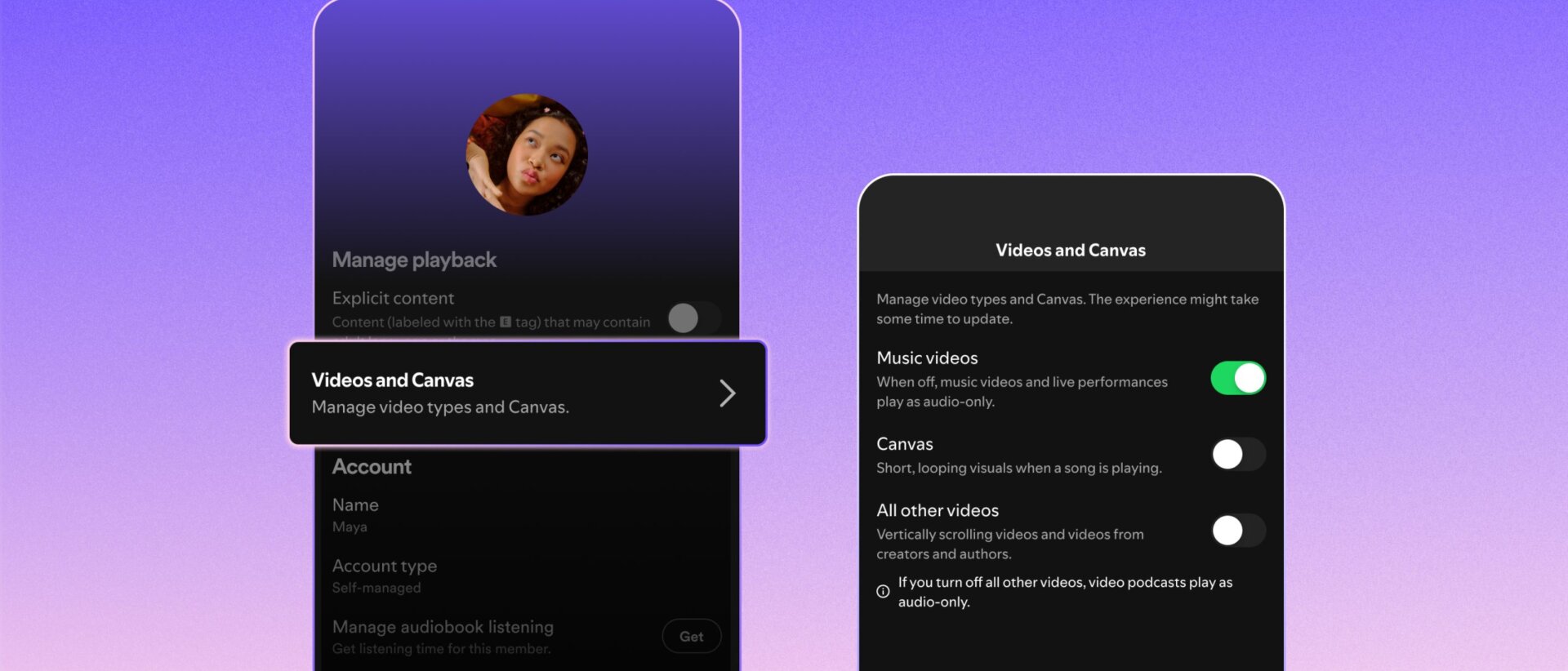
The new controls enable Family Plan subscribers to manage video visibility for any plan member through subscription settings, extending existing parental restrictions that previously applied only to accounts for users under 13 years old. All Premium, Basic, Individual, Duo, Family, Student, and free-tier users will gain access to granular video settings, allowing them to disable Canvas looping visuals and videos for music, podcasts, and audiobooks across mobile, desktop, web, and television applications. Users will access the feature through Settings, then Content and Display, where preferences apply uniformly across all devices and platforms. Video advertisements and Canvas-like visuals on audio ads will continue to display regardless of user settings.
The feature rollout follows months of internal development focused on what Spotify characterizes as user agency in the streaming experience. According to a Burson survey of 8,400 respondents across 19 markets conducted August 27 through October 3, 2025, 93 percent of Spotify users expressed enthusiasm for features offering greater control, and 92 percent reported that the platform brings them closer to content they love. The company has progressively expanded user preference controls through initiatives including Taste Profile personalization, Prompted Playlist functionality, managed accounts expansion, and Smart Filters. Gustav Söderström, co-chief executive officer of Spotify, described the video controls as integral to the company’s philosophy of intentional engagement, stating that control transforms how users perceive time spent on the platform. “Control changes everything,” Söderström said in company messaging accompanying the announcement. “Time stops feeling wasted and starts feeling owned.”
For podcast producers and audio professionals, the video control feature carries significant implications for content strategy and audience engagement. Podcasters who have incorporated video elements—either through promotional materials, visual companion content, or Canvas-compatible assets—will need to account for listeners actively disabling video playback. This represents a bifurcation of the listening audience into those preferring traditional audio-first experiences and those embracing multimedia consumption. Producers may need to develop dual content strategies ensuring narrative and informational integrity regardless of whether listeners engage with visual components. Audio engineers and podcast professionals should prepare for analytics showing variable video engagement rates across their listener base, potentially requiring separate measurement frameworks for audio-only and video-enabled consumption. Independent creators relying on visual supplementation to distinguish content in a crowded market may face reduced discoverability among users who disable video features.
The announcement reflects broader industry trends toward algorithmic personalization and user agency within streaming ecosystems. Apple Podcasts, owned by Apple Inc., has implemented limited video support through proprietary tools but lacks comparable granular controls for listeners to customize visual presentation. Amazon Music, the audio streaming service operated by Amazon.com Inc., offers video content through integration with music videos and artist content but does not provide equivalent family-level video management at the plan member level. YouTube Music, part of Alphabet Inc.‘s portfolio, inherently prioritizes video as a core component and offers limited audio-only viewing options, contrasting sharply with Spotify‘s audio-first philosophy. iHeartMedia Inc., a terrestrial radio and digital audio broadcaster, focuses primarily on audio streams and does not offer comparable video integration. SiriusXM Holdings Inc. similarly maintains audio-centric delivery across satellite and digital platforms. Spotify‘s approach to video controls positions it as uniquely responsive to listener preferences regarding visual versus audio-primary experiences, distinguishing its platform architecture from competitors that either embrace video as fundamental or maintain strict audio-only models.
Spotify reported 602 million monthly active users as of the fourth quarter 2025, with 226 million Premium subscribers across individual, family, duo, and student plan categories. The company generated $3.67 billion in total revenue during 2025, with advertising revenue accounting for approximately $1.3 billion, reflecting sustained growth in the advertising tier and ad-supported listening segments. Premium subscription revenue grew to approximately $2.37 billion, demonstrating continued monetization of the subscription base despite intensifying competition from Apple Music, Amazon Music, and YouTube Music. The Family Plan, which bundles multiple user accounts under single billing, represents one of Spotify‘s highest-margin offerings and drives engagement metrics that distinguish household penetration from individual subscriber counts. Video content, including Canvas features and video clips accompanying music tracks, has become integral to user engagement metrics, with the company tracking video play rates, view duration, and completion percentages as secondary engagement indicators supplementing traditional streaming metrics.
Spotify was founded in 2006 by Daniel Ek and Martin Lorentzon in Stockholm, Sweden, launching commercially in 2008 with a freemium model combining ad-supported listening with paid Premium tiers. The platform expanded internationally throughout the 2010s, entering the United States market in 2011 and subsequently pursuing aggressive acquisition and partnership strategies to expand podcast and audio content offerings. The 2019 acquisition of Gimlet Media, a podcast production company, marked Spotify‘s first major push into exclusive podcast content, followed by deals with creators including Joe Rogan, Dax Shepard, and Michelle Obama. By 2021, Spotify had invested more than $1 billion in podcast content acquisition and production, establishing podcasting as a strategic pillar alongside music streaming. The introduction of video components, including Canvas looping visuals and video clips, began rolling out experimentally in 2020 and 2021, initially in select markets before broader global availability. Throughout this period, Spotify maintained its audio-first identity while selectively integrating visual elements to capture engagement minutes and compete with video-dominant platforms.
Competitive positioning around video content and user controls reveals distinct industry strategies. Apple Podcasts, integrated within Apple Inc.‘s ecosystem spanning iPhone, iPad, Mac, Apple Watch, and HomePod, offers limited video integration and relies instead on native notification controls and subscription management through Apple‘s system preferences. Amazon Music bundles music and podcasts with video through Amazon Prime Video integration but does not offer granular plan-member-level video controls comparable to Spotify‘s Family Plan features. YouTube Music positions video as primary, offering users background-only audio playback on Premium subscriptions rather than defaulting to audio-first with optional video overlay. iHeartRadio, the streaming application from iHeartMedia, maintains traditional broadcast radio streaming with minimal video integration and targets automotive and portable listening without comparable visual personalization. SiriusXM, through satellite and internet radio services, emphasizes talk, music, and sports content in audio format exclusively. Podcasting platforms including Apple Podcasts, Podcast Addict, and independent podcast hosting services generally do not offer video as platform-native features, positioning Spotify as a relative innovator in video-enabled podcast consumption, though the company’s user controls acknowledge market demand for audio-only engagement.
Industry reaction to the video controls announcement reflected measured acknowledgment of user preference features without significant controversy or concern. Podcast industry analysts did not report major pushback from creators regarding the controls, though some observers noted that reduced video visibility could impact discoverability for podcasters who had invested in visual companion content strategies. Engagement metrics analysis from podcast analytics firms indicated that video completion rates on podcast content typically ranged from 15 to 40 percent depending on genre and audience demographics, suggesting that enabling video opt-out would not substantially disrupt overall platform engagement for audio-focused creators. Social media commentary from podcasters and audio professionals expressed mixed sentiment, with some praising listener agency and others expressing concern about fragmented audience analytics. No major creator organizations or podcasting associations issued formal statements regarding the controls, indicating relatively low controversy threshold within the professional podcast community.
Upcoming rollout milestones include global availability of video controls by April 30, 2026, with Spotify committing to unified implementation across all application platforms simultaneously. The company indicated additional feature development in announcements accompanying the video controls rollout, referencing forthcoming personalization enhancements and content discovery tools. Regulatory considerations regarding user data, parental controls, and content restriction align with evolving European Union digital services framework and national regulations governing digital platforms’ responsibility for content safety. Spotify did not specify timelines for additional features but indicated active product development roadmaps extending through 2026 and beyond. The company has historically implemented feature rollouts gradually, using geographic and demographic segment testing before global deployment, suggesting that video control enhancements and related tools may continue rolling out incrementally rather than as single comprehensive updates.
For working podcast producers and audio engineers, the video controls feature necessitates strategic reconsideration of content supplementation and audience measurement frameworks. Producers should audit existing podcast video assets—including intro sequences, guest introductions, call-to-action graphics, and promotional materials—to assess dependency on visual elements for narrative clarity or listener comprehension. Podcasts that utilize visual reference materials or on-screen graphics to convey critical information should prepare alternative audio descriptions or restructure content to ensure full comprehension for listeners with video disabled. Analytics teams managing Spotify promotion and audience tracking should establish separate measurement frameworks distinguishing audio-only listeners from video-engaged audiences, tracking conversion, retention, and engagement metrics independently. Audio engineers should verify that podcast audio mix, pacing, and production quality perform effectively in isolation without relying on visual timing cues or graphic annotations to maintain listener engagement. Independent creators evaluating investment in video-supplemented podcast content should model audience size reductions accounting for users disabling video playback, potentially reducing return on investment for visual content production. Podcast networks and production companies should develop style guides and production standards addressing video-optional workflow processes and ensuring consistency across team output regardless of listener video preferences.
The video controls announcement reflects the broader media industry transformation toward audio-first consumption balanced against visual engagement optimization. Streaming platforms increasingly recognize that listening contexts—commuting, exercise, household tasks, work environments—frequently preclude active visual attention, creating demand for audio-optimized experiences. Simultaneously, competitive pressure from video-dominant platforms including TikTok, YouTube Shorts, and Instagram Reels incentivizes audio platforms to incorporate visual engagement mechanisms. Spotify‘s approach—offering both audio-only and video-enhanced pathways with granular user controls—represents a pragmatic industry strategy acknowledging dual audience preferences. The broader podcasting industry has similarly bifurcated, with traditional talk and interview content remaining predominantly audio-only while entertainment, true crime, and narrative fiction podcasts increasingly incorporate video supplementation. Audiobook listeners show particularly strong preference for audio-only consumption, requiring Spotify‘s Audiobooks tier to remain video-optional. This trend reflects market fragmentation wherein single one-size-fits-all content strategies increasingly disadvantage creators, requiring tailored approaches for video-enabled and audio-only audiences.
Looking forward, the video controls feature signals Spotify‘s commitment to listener agency and customization as competitive differentiators in an increasingly crowded audio streaming marketplace. As podcast and music platforms expand visual content offerings to capture engagement and compete with entertainment-focused competitors, user controls enabling audio-first preference will likely become standard functionality rather than premium differentiation. Podcast creators, audio engineers, and producers should interpret the rollout as validation that audio-centric consumption remains substantial enough to justify dedicated platform engineering, even as visual content becomes increasingly common. The feature’s global implementation across all subscription tiers and service levels demonstrates Spotify‘s belief that listener control extends beyond premium-paying segments, encompassing free-tier users and basic subscribers. For the broader podcast industry, the video controls represent equilibrium between innovation and user preference, suggesting that platform development will continue balancing audio optimization with selective visual supplementation. Producers should prepare for increasingly segmented listener bases requiring dual-track content strategies, while analytics and measurement frameworks adapt to account for variable video engagement. The evolution reflects maturation of the podcast industry beyond novelty phase, toward sustainable business models acknowledging diverse listener preferences and consumption contexts.
Source: Spotify Newsroom — Read the original article →