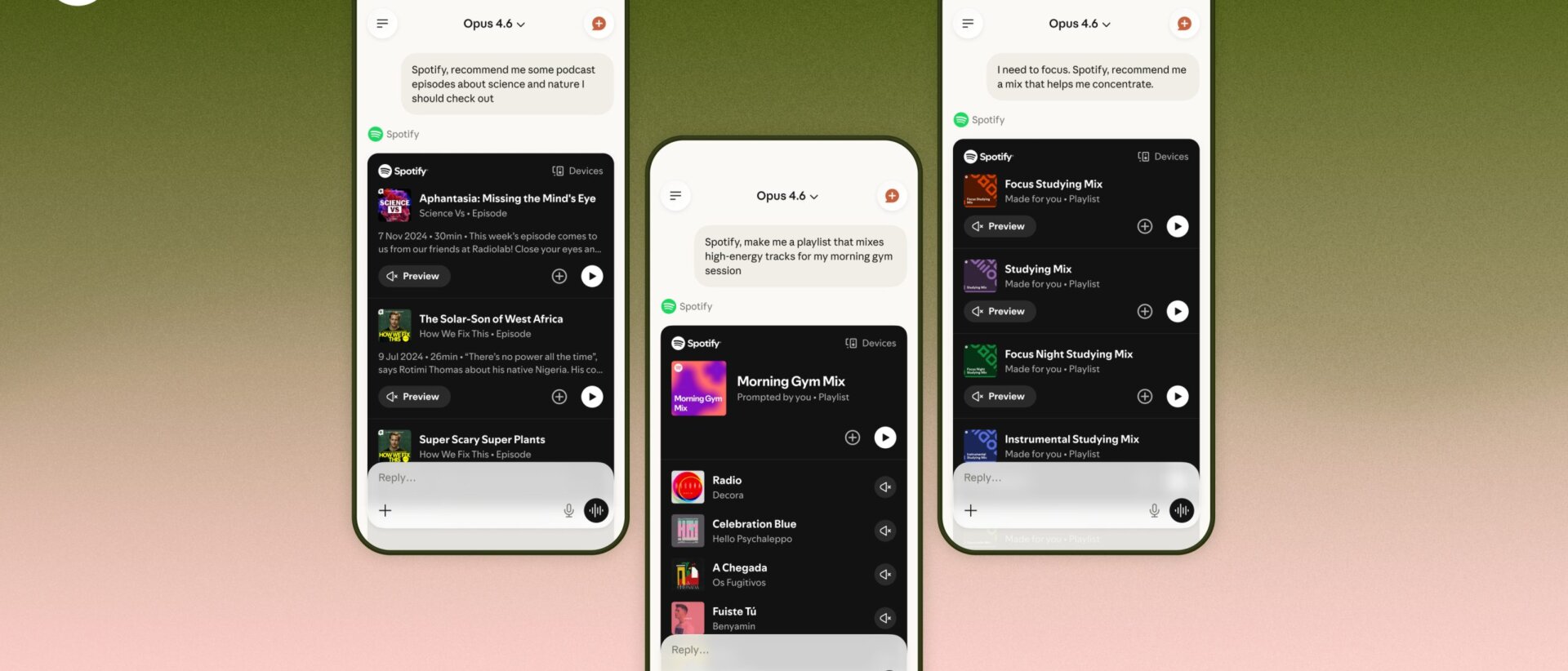
Spotify has launched an integration with Claude, the artificial intelligence chatbot developed by Anthropic, allowing users to receive personalized music and podcast recommendations directly within the conversation platform as of April 23, 2026.
The integration enables Spotify users to connect their accounts to Claude and request recommendations based on their listening history and music taste. Users can ask for podcasts suited to their commute, playlists from favorite artists, or high-energy tracks for workout sessions without leaving the chat interface. Both free and premium Spotify listeners have access to the feature, though premium subscribers can request recommendations based on specific moods or vibes. The recommendations leverage Spotify‘s personalization technology and catalog expertise.
The move reflects growing collaboration between major technology and media companies to embed entertainment services within conversational AI platforms. Spotify has been expanding its integration strategy across digital ecosystems, while Anthropic continues building out Claude‘s utility beyond text-based responses. The integration is available globally across Claude‘s free, pro, and max subscription tiers on web, mobile, and desktop platforms.
Spotify emphasized in its announcement that users maintain full control over the integration and can disconnect their accounts at any time. The company stated it does not share music, podcasts, or other audio or video content from its platform with Anthropic for AI model training purposes, addressing privacy concerns that have accompanied similar AI-media partnerships.
The integration includes Spotify Connect functionality, enabling users to view which devices are currently playing Spotify and switch between them from within Claude. Users can control playback across phones, laptops, and speakers directly through the chat interface, then open tracks or playlists in the Spotify app for full functionality. The preview and save features allow users to test recommendations before committing to a full listen.
Industry analysts view the development as a significant expansion of Spotify‘s reach beyond its primary mobile and web applications. The integration provides podcast creators and artists with an additional discovery channel, potentially increasing listener engagement through conversational recommendations rather than algorithmic feeds or search. For podcast producers, the partnership represents a new avenue for audience growth as listeners increasingly discover content through AI assistants.
The integration highlights the broader trend of media platforms embedding their services within third-party AI tools to maintain relevance as user behavior shifts toward conversational interfaces. Spotify‘s move to integrate with Claude follows similar partnerships between other streaming and entertainment companies with AI platforms. The audio industry is seeing accelerated adoption of AI-powered recommendation systems, which now span traditional streaming apps, smart speakers, and conversational AI assistants. As artificial intelligence chatbots become primary information and content discovery tools for many users, streaming services face pressure to establish native integrations rather than relying solely on their own platforms.
The Spotify–Claude partnership underscores how the podcast and music industries are adapting to fragmented consumption patterns. Listeners no longer discover content exclusively through dedicated apps but increasingly encounter recommendations through multiple touchpoints. For content creators, the expanded distribution through AI assistants like Claude offers opportunities to reach audiences in new contexts—during work, research, or conversation rather than dedicated listening sessions. As AI assistants become more integrated into daily workflows, media companies must ensure their content remains accessible and discoverable across platforms to compete for listener attention in an increasingly competitive audio landscape.
Source: Spotify Newsroom — Read the original article →